Traxyl
Tranexamic Acid BP 500mg
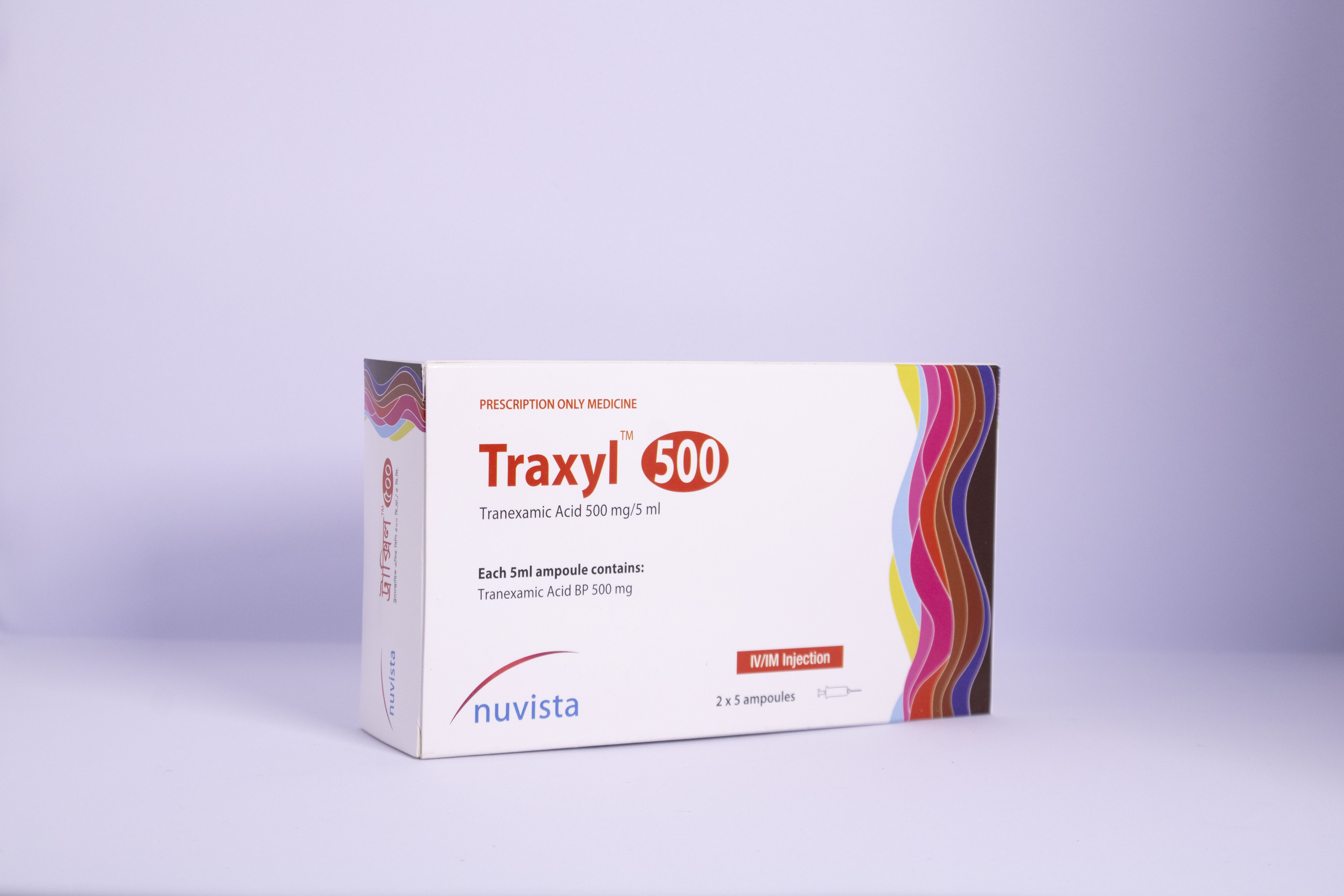
Dosage Form: Capsules and InjectionPack Size: 3 X 10's capsules, 2 X 5 ampoules
Composition:
TraxylTM 500 Capsule: Each capsule contains Tranexamic Acid BP 500mg.
TraxylTM 500 Injection: Each 5 ml colorless solution contains Tranexamic Acid BP 500 mg.
Tranexamic acid is an antifibrinolytic agent (analogue of aminocaproic acid) which competitively inhibits the activation of plasminogen to plasmin.
Pharmacokinetics:
Absorption of Tranexamic acid from gastro-intestinal tract is 30-40%. Approximately 90% of an intravenously administered tranexamic acid dose is excreted, largely unchanged, in the urine within 24 hours. The plasma half-life is approximately 2 hours.
Indications:
1. Local fibrinolysis
a) Prostatectomy
b) Menorrhagia
c) Epistaxis
d) Conisation of the cervix
e) Traumatic hyphaema
f) Surgical procedures and dental extractions in haemophiliacs
2. General fibrinolysis
a) Haemorrhagic complications in association with thrombolytic therapy
b) Haemorrhage associated with disseminated intravascular coagulation
with predominant activation of the fibrinolytic system
Dosage & Administration:
1. Local fibrinolysis:
The recommended standard dose is 15-25 mg/kg body wt. i.e. 2-3 capsules two to three times daily or 5-10 ml (500-1000 mg) by slow intravenous
injection (1 ml/min), three times daily. For the indications listed below the following doses may be used:
a) Prostatectomy: Prophylaxis and treatment of Haemorrhage in high risk patients should commence per- or postoperatively with Traxyl 500 Injection, thereafter 2 capsules three to four times daily until macroscopic hematuria is no longer present.
b) Menorrhagia: 2-3 capsules three to four times daily for three to four days. TraxylTM therapy is initiated only after heavy bleeding has started.
c) Epistaxis: Where recurrent bleeding is anticipated, oral therapy with 2 capsules three times daily should be administered for seven days.
d) Conisation of the cervix: 3 capsules three times daily.
e) Traumatic hyphaema: 2-3 capsules three times daily. The dose is based on 25 mg/kg three times a day.
f) Hemophilia: In the management of dental extractions 2-3 capsules every eight hours. The dose is based on 25 mg/kg.
2. General fibrinolysis:
In disseminated intravascular coagulation with predominant activation of the fibrinolytic system, usually a single dose of 10 ml (1 g) is sufficient to control bleeding.
Neutralization of thrombolytic therapy; 10mg/kg body wt. by slow intravenous injection.
Hereditary angioneurotic oedema: Some patients are aware of the onset of illness; suitable treatment for these patients is intermittently 2-3 capsules two to three times daily for some days. Other patients are treated continuously at this dosage.
Children
Oral dose : 25 mg/kg body wt. /2 to 3 times daily.
Injection : 10 mg/kg body wt. /2 to 3 times daily.
Elderly patients
No reduction in dosage is necessary unless there is evidence of renal failure.
Contraindications:
TraxylTM is contraindicated in patients with a history of thromboembolic disease.
| Serum Creatinine (micromole/L) | Oral Dose | IV Dose | Dose Frequency |
| 120-250 | 25 mg/kg | 10 mg/kg | Twice daily |
| 251-500 | 25 mg/kg | 10 mg/kg | Every 24th hour |
| >500 | 12.5 mg/kg | 5 mg/kg | Every 24th hour |
Warning & Precautions:
-In patients with renal Insufficiency, because of the risk of accumulation, the dose should be reduced according to the following table:
• In massive hematuria from the upper urinary tract (especially in hemophilia) since, in a few cases; ureteric obstruction has been reported.
- In patients with disseminated intravascular coagulation (DIC), treatment must be restricted to those in whom there is predominant activation of the fibrinolytic system with acute severe bleeding. Characteristically, the hematological profile approximates to the following: reduced euglobulin clot lysis time; prolonged prothrombin time; reduced plasma levels of fibrinogen, Factors V and VIII, plasminogen and alpha-2 macroglobulin; normal plasma levels of P and P complex, i.e. factors II (prothrombin), VII and X; increased plasma levels of fibrinogen degradation products; a normal platelet count. The foregoing presumes that the underlying disease state does not of itself modify the various elements in this profile. In such acute cases a single dose of 1 g tranexamic acid is often sufficient to control bleeding. The fibrinolytic activity in the blood will be reduced by about 4 hours if renal function is normal. Anticoagulation with heparin should be instigated to prevent further fibrin deposition. Administration of Traxyl 500 in DIC should be considered only when appropriate hematological laboratory facilities and expertise are available. TraxylTM 500 must not be administered in DIC with predominant activation of the coagulation system.
- In the long-term treatment of patients with hereditary angioneurotic oedema regular eye examination (e.g. visual acuity, slit lamp, intra-ocular pressure, visual fields) and liver function tests should be performed.
Overdose:
No cases of overdosage have been reported. Symptoms may be nausea, vomiting, orthostatic symptoms and/or hypotension. Initiate vomiting, then stomach lavage and charcoal therapy. Maintain a high fluid intake to promote renal excretion.
Storage Conditions:
For capsule: Store below 30°C, frost free & dry place. Protect from light. Keep out of the reach of children. For injection: Store below 30°C & frost-free place. Protect from light. Keep out of the reach of children.
Commercial Pack:
TraxylTM 500 Capsule: Each box contains 3 x 10's capsules in Alu-PVC blister strip.
TraxylTM 500 Injection: Each box contains 2 x 5's ampoules in Alu-PVC blister strip.